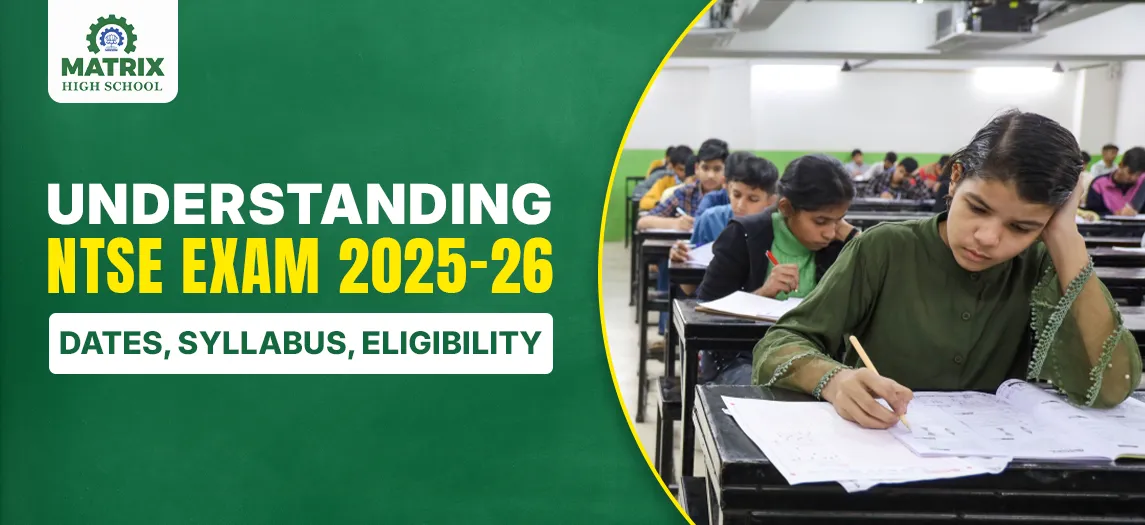
NTSE refers to the National Talent Search Examination. It is one of the most renowned scholarship exams conducted by NCERT, which stands for the National Council of Educational Research and Training. It tests students’ ability in subjects such as Physics, Chemistry, Mathematics, Social Science, English and General Knowledge.
The NTSE helps identify capable students early and motivates them to pursue strong careers in science research, technology, and social sciences. The competency level of the NTSE Examination is very high.
This exam is mainly divided into 2 types of tests: the MAT (Mental Ability Test) and the SAT (Scholastic Aptitude Test). The NTSE exam is conducted in two stages: Stage one and Stage two. Students wishing to take the exam must meet specific eligibility criteria set by NCERT.
The following article will help you gain more clarity.
Important Dates
Before appearing for the NTSE exam, students should know that the exam is conducted in two stages. The very first stage is usually held in November 2025, while the second stage is held in June of the very next year. Note: If there is any change to the stage two exam pattern, it will be updated and informed later (not immediately). The table below lists the expected dates for the NTSE stage one and stage two exams.
| Important Event | Stage 1 (Tentative Dates) | Stage 2 (Tentative Dates) |
| NTSE Notification 2025 | October 2025 | Not yet announced |
| Registration Starts | October 2025. | No registration. |
| Registration Ends | October 2025. | No registration. |
| NTSE Admit Card release | October 2025. | May 2026. |
| NTSE Exam Date | 1st Sunday of November. | June 2026. |
| NTSE Result | Aug-Sept 2026. | To be declared later. |
| NTSE Score Card | Aug-Sept 2026. | To be declared later. |
NTSE 2025 Highlights
To appear for the exams, you must know the key details about the exams, so here we are providing you with the highlights of the NTSE 2025 Exam.
| Organization | National Council of Education Research and Training (NCERT) |
| Exam Name | National Talent Search Examination (NTSE). |
| Total Scholarships | 2000. |
| Exam Duration | 120 minutes(2 hours). |
| Mode of Application | Online and Offline modes. |
| NTSE Exam Mode | Offline (Pen and paper-based). |
| NTSE 2025 “The selection process” | NTSE Stage 1 (State Level) and NTSE Stage 2 (National Level). |
| Educational Qualification | Students in Class 10. |
| Age Limit for NTSE | Below 18 years. |
| Scholarship | Higher Secondary level – Rs. 1250/- p.m.Graduate and Post Graduate – Rs. 2000/- p.m. (3 Years),For a PhD. Degree 2000/- (four years) – As per UGC norms. |
| Official Website | ncert.nic.in/national-talent-examination.php |
NTSE Exam Pattern and Syllabus 2026
While the exam doesn’t have an official prescribed syllabus like other competitive exams, the questions are designed to align with the educational standards of Classes 9 and 10.
However, the NTSE exam consists of two main written tests- MAT and SAT. Both sections are based on multiple-choice questions (MCQs) that test critical thinking and concept clarity. The syllabus covers:
- Mathematics- algebra, geometry, arithmetic, probability, statistics.
- Science- physics (motion, work and energy, electricity), chemistry (structure of atom, periodic classification), biology (life processes, heredity).
- Social Science- history, geography, physics, economics.
- Mental Ability- reasoning, analogy, series, classification, coding, decoding.
- English and General Knowledge.
Here’s a table for you to understand the NTSE Exam sections better:
| Section | Description | Example Question |
| MAT | Tests reasoning and problem-solving skills. | Number series/ Analogy. |
| SAT: Mathematics | Problem-solving in algebra, arithmetic, and geometry. | Find x in 2x+5= 13 |
| SAT: Science | Conceptual questions in Physics, Chemistry, and Biology. | What is Newton’s Third Law? |
| SAT: Social Science | Indian and world history, civics and geography. | Who wrote the Indian Constitution? |
NTSE Exam Pattern
Understanding the NTSE exam pattern will be helpful, the way the exam will be conducted and in creating a proper preparation schedule. As per the details provided by officials about the exam pattern, NTSE is conducted in two phases. The candidates who clear the 1st round will be considered eligible for the 2nd one, i.e., the national level exam. Below, we have provided the detailed exam patterns for both stages:
- NTSE Stage-One Exam Pattern:
Stage one of the NTSE will be conducted at the state level by the respective state administrations. Aspirants can choose to take the test in either English/Hindi. Each correct answer will gain you one mark. There will be no unnecessary deductions in marks for wrong answers. The examinations comprise two parts:
| Section | No. of Questions | Max Marks | Question Type | Distribution of Questions | Marking Scheme | Duration |
| (MAT) Mental Ability Test | 100 | 100 | MCQs | Null. | +1 for each correct answer, no negative marking. | 2 hours. |
| (SAT) Scholastic Aptitude Test | 100 | 100 | MCQs | Science: 40Social Science: 40Mathematics: 20. | +1 for each correct answer, no negative marking. | 2 hours. |
- NTSE Stage-Two Exam Pattern:
Candidates who pass the stage one exam will be considered eligible for the stage two exam. Stage two follows a similar structure to stage one, with MAT and SAT sections containing 100 questions. Science: 40, Mathematics: 20, and Social Science: 40. Each test lasts 2 hours, and there will be absolutely no deductions of marks for stage two as well.
Also Check: CBSE Class 10 Exam 2026 Pattern Changed.
Eligibility and Registration
According to CBSE guidelines, NTSE is accessible to all students from Indian Nationality at the Class 10 level or below 18 years of age, regardless of whether they are pursuing their studies in India or overseas. This means students under ODL (Open Distance Learning) can also apply, provided they are appearing in Class 10 for the first time or are below the age of 18. Students from both the state board and CBSE can apply.
- For Students In India:
- A screening test will determine eligibility.
- Candidates who successfully pass the screening test qualify for the NTSE Exam.
- For Students Studying Abroad: These students can skip stage one of NTSE and directly take the stage two exam.
Eligibility Criteria for Stage One
- The candidates should have scored at least 60% in Class 9.
- The candidate must be enrolled in a school that is nationally recognised in India.
- ODL (Open Distance Learning) students can apply if they are below 18 years old on July 1 of the exam year and are not employed.
Eligibility Criteria for Stage Two
Only candidates who pass the Stage One exam can appear in the NTSE Stage Two exam.
Must Read: How to Score 95% in Class 10.
Registration
The registration is usually done through schools, state education departments, or the official NCERT portal. The NTSE exam fee and process can vary; check the latest notification for more information on deadlines and details. Visit the official website: NCERT (National Council of Research and Training). You might be wondering whether there’s an application fee or not. The answer is no. NCERT doesn’t charge a fee for the NTSE exam. However, if you apply through your state for the exam, your state may charge a fee. So, the application cost can differ in each state or union territory.
NTSE Admit Card
In order for candidates to check in, they must bring their admit card to the exam centre. Both stages will have their separate admit cards. The stage two admit card will be available online two to four weeks before the exam.
Candidates must note that each state releases the NTSE stage on the admit card at different times. Some states provide these admit cards online, while others prefer giving them out through schools.
Students should collect their NTSE stage one admit cards from their school or download them online from the official website using their application number and date of birth. The admit card includes the necessary information like exam location, roll number, date, and time.
NTSE 2025-26 Results Announcement Process
After conducting both stages of the exam, the final merit list will be published.
- State/Union Territory prepares merit lists based on minimum qualifying marks in both tests.
- Qualifying marks are 40% for General and OBC candidates and 32% for SC/ST/physically challenged candidates.
- State Level Talent Search examination results are declared in January/February by the respective States/UTs.
- This examination is a recommendation for the second-level NTS examination conducted by the NCERT.
- Marks obtained in the State-level examination are not considered for the national scholarship.
- NCERT does not handle correspondence regarding the first-level examination conducted by the State/UT.
- Candidates with queries or complaints should correspond with the state examination agencies for the State Level Examination.
Steps to Check the NTSE Result 2025-26
To check the final result of the NTSE 2025-26 exam, follow these instructions:
- Visit the official website of NCERT.
- Look for the “NTSE 2025” section and click on it.
- Find the link for “NTSE Result 2025” and click on it.
- The complete list of NTSE 2025-26 results, including a merit list, will be available.
- Search for your name or roll number in the list to see if you have qualified.
NTSE Scholarships
The NTSE scholarships are awarded as follows:
- Rs. 1250/- per month for students in classes 11 and 12.
- Rs. 2000/- per month for UG and PG students.
- Scholarships for PhD students are provided according to UGC norms.
Why Is NTSE Important?
The NTSE exam is highly regarded not only for offering recognition but also for scholarships at different educational levels. But what about the ones who qualify? Are there any rewards or recognition for them? The answer is yes. As discussed, the NTSE exam offers scholarships for students at different educational levels. Qualifying students receive financial support up to the doctoral level, which can later be helpful for exams such as JEE, NEET and future research careers. The skills and confidence gained from the NTSE examination will benefit students across all future competitive exams.
Real-World Applications
People often think that the NTSE Exam is another national-level exam which will provide their children with a strong foundation for competitive exams like JEE and NEET, which is partially true. But what they don’t realise is that the competency of this exam also strengthens reasoning and problem-solving skills for real-life situations. Understand it this way: the physics section, for example, directly relates to topics like the distance-time graph and the difference between force and pressure, which have both academic and real-life value.
Conclusion
It’s known that the NTSE exam is one of the most respected scholarships in India. It provides talented and capable students of India with an opportunity to earn financial support. With the right preparation, it helps students build good reasoning abilities, problem-solving and academic skills that are not only helpful in school but also in real-life challenges. It prepares students for future competitive exams by making it fun for them and by offering various scholarships and rewards. By understanding the exam pattern and awareness of important dates, students can confidently clear both stages of the NTSE exam.
FAQs
Ans. Qualifying for the NTSE exam provides significant benefits, primarily a scholarship to support your higher education. This financial assistance can greatly reduce the burden of educational expenses. Furthermore, the achievement itself can boost your academic profile and enhance future college applications.
Ans. Yes, there are age restrictions for the NTSE. The upper age limit varies by state. It’s important to check the specific guidelines for your state on the official website of NCERT to confirm that you meet the age criteria before registering for the exams. Failing to meet the age requirements will make you ineligible.
Ans. The NTSE 2025 registration is expected to open soon, with state-specific details to be provided. For the NTSE 2026 cycle, registrations are expected to start in August 2025, available through both online and offline modes.
Ans. No, the NTSE exam is mainly for students who have completed or are about to complete Class 10, including those enrolled in ODL (Open Distance Learning). Students in Class 11 are not eligible.