

Robotics labs in schools play a vital role in preparing students for the future by promoting STEM education, fostering creativity, and equipping students with essential technical skills. These labs encourage hands-on learning through real-world applications of science, technology, engineering, and math. They help students develop problem-solving, coding, and programming skills while nurturing qualities like teamwork, leadership, and perseverance. Robotics labs also spark innovation, enhance technological literacy, and make learning fun and engaging. By introducing students to automation, AI, and robotics, schools help them build a strong foundation for future careers in a tech-driven world, ensuring they are future-ready.
As technology continues to transform the world, schools are increasingly adopting robotics education to prepare students for future careers. Robotics labs provide students with hands-on learning experiences that enhance creativity, critical thinking, coding skills, and problem-solving abilities. These labs help bridge the gap between classroom learning and real-world applications, making education more interactive and future-focused.
10 Benefits of Robotics Labs in School for Students
Robotics labs are transforming the way students learn by combining technology with practical education. They help students develop technical skills, creativity, critical thinking, and problem-solving abilities while making learning more interactive and engaging. Below are 10 key benefits of robotics labs that help students become future-ready learners.
1. Encourages STEM Learning
We live in a STEM world, Science, Technology, Engineering, Mathematics, and a robotics lab is a starting point. STEM education through robotics translates all theories into real life, making it easy for students to learn why things are done in a particular way in addition to how they are done.
What makes it so different from others is that here it’s not about memorisation or a test; instead, students brainstorm and operate on actual situations. For example, building a maze-solving robot is not only a fun activity, but it also involves learning geometry, physics, and computational thinking all at once.
2. Enhances Problem-Solving Skills
Problem-solving is an important part of robotics labs in schools. For instance, a robot is not turning left according to the desired plan; this problem needs to be explained by students and how they plan to overcome it. Possible reasons could be a coding error, a mechanical issue, etc. This helps students learn about problem-diagnosing and problem-solving skills.
All while going through this process, students learn bookish knowledge and how it helps them in their practical life. Robotics projects often require students to identify errors, test different solutions, and improve their designs through trial and error. This process strengthens analytical thinking and teaches students how to approach challenges systematically.
3. Prepares Students for Future Careers
Automation, Artificial Intelligence, and Robotics are the way of the future. Students who develop technical skills at an early age are often better prepared for future careers in engineering, artificial intelligence, computer science, automation, and emerging technologies. A robotics lab in school serves as a ground zero for them to learn about these new skills and get ready for the future.
These labs help students get real-world exposure to using technologies that they would encounter in their professional lives. These include things like programming a microcontroller, identifying what a sensor is, or how to deal with AI systems. By giving students early exposure, they become confident and are prepared for the competitive marketplace by having an edge above the rest.
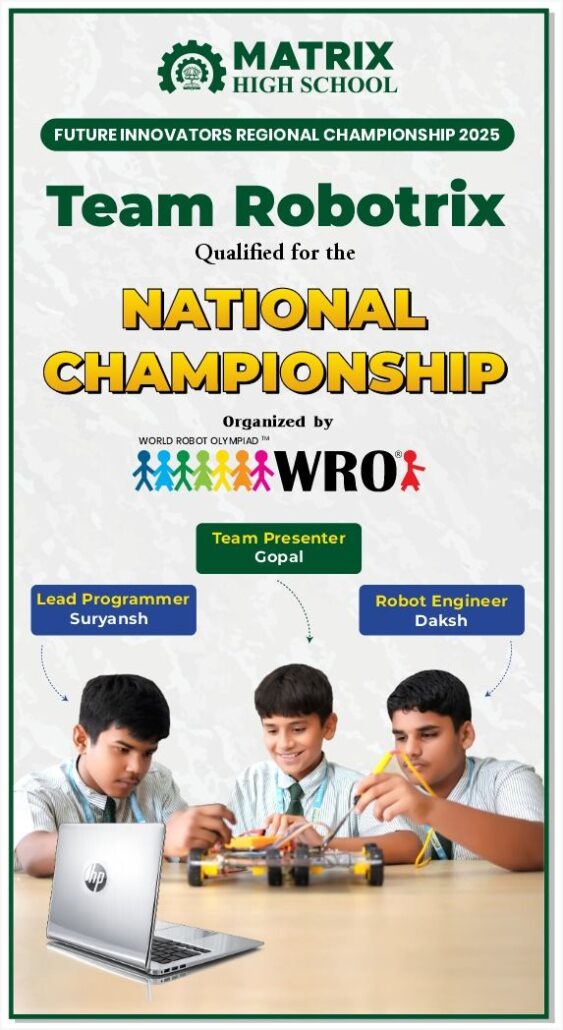
3 of Matrix High School’s talented students, Suryansh, Gopal, and Daksh, qualified for National Championship organised by WRO in 2025.
4. Promotes Teamwork and Collaboration
Group assignments are one of the main parts of robotics labs. Because robot development and coding are very often team efforts, a number of people need to devise, distribute the workload, and collaborate.
For example, one student may be a coding champion, but another may be better at putting together the gadgets. Putting together these skills makes students understand the aspect of teamwork and how to coordinate their strengths for the achievement of a common goal.
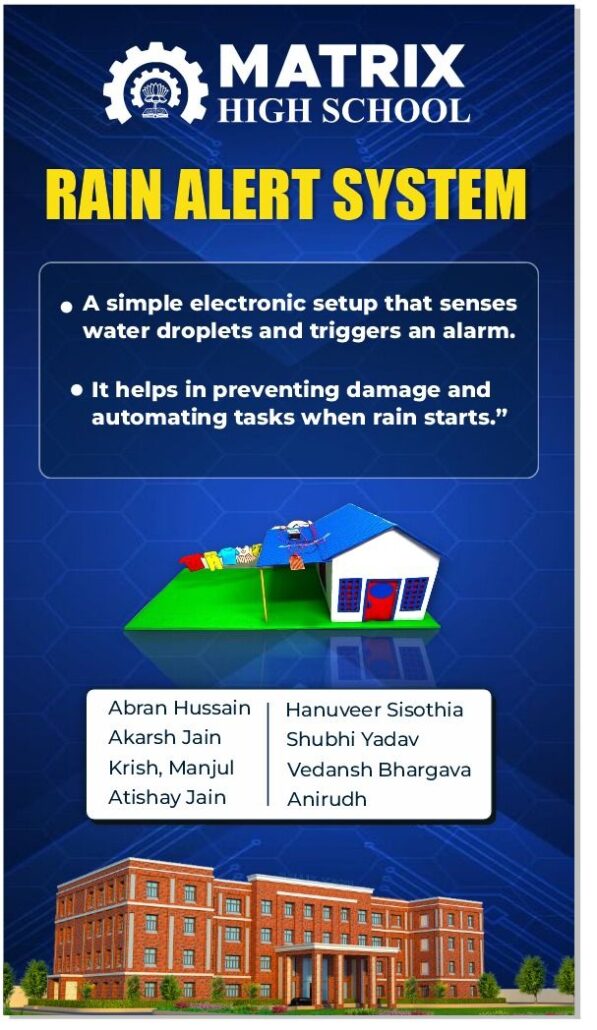
For example, students at Matrix High School designed and built a Rain Alert System using Arduino Uno, a rain sensor, and a buzzer to detect water droplets and automatically trigger an alarm. Through this project, they learned the fundamentals of sensor interfacing, Arduino programming, electronic circuits, and automation while developing practical problem-solving, debugging, and teamwork skills by applying technology to solve a real-world challenge.
5. Develops Coding and Programming Skills
Coding is the language of the present, and the way to future success and robotics is an interesting place to learn it. Just think about setting a robot to draw along a line or reach with its wheels – it is fun and at the same time lays the roots of coding languages such as Python, Java, or C++.
Also, students acquire skills like critical thinking, problem-solving, etc. Students get to apply this knowledge by working on real-life projects related to robots, in which they strengthen their understanding of both the basic and complex concepts of coding.
Key Coding Skills Students Learn:
- Logical Thinking
- Algorithm Design
- Debugging
- Python Basics
- Robotics Programming
- Computational Thinking
6. Sparks Creativity and Innovation
Robotics labs are sort of like playgrounds for students’ creativity and imagination. Students are not just assembling robots; instead, they are designing solutions and acquiring life skills like problem-solving, critical thinking, etc.
For instance, a student may build a robot to water plants or sort out waste. These are solutions to real-life problems and make a big difference. This nurtures them to look at what is realistically there and envision what can be created out of it – a creativity and innovation-friendly ambience.
7. Builds Resilience and Patience
Let’s face it: not all robots perform a task without a hitch for the first time. And that’s the beauty of it. Even if they show mere misconceptions, such as a miswired circuit or a wrong calculation in coding, the students will have to persevere. Students learn that failure is often a stepping stone to innovation, helping them develop a growth mindset.
This is very important for students to learn and inculcate as a part of their being. For example, each loss proves that patience and perseverance pay off, especially during competitions. And, these competitions don’t just end at robotics, and the same goes for the learning in the robotics labs.
8. Makes Learning Fun and Engaging
Education doesn’t have to be like a boring chore. This can be avoided by making learning unique and interesting by helping students understand the theoretical and practical aspects of learning at the same time, and the robotics lab in school is a good place to start.
Just envision students excited to put the mechanical parts together, calibrate sensors, or program movements; they are learning, but at the same time, they have the opportunity and liberty to innovate! Such a system automatically keeps students on their toes and at the same time makes learning and most importantly comprehending a fun challenge.
How Robotics Makes Learning Engaging:
- Hands-on experimentation
- Interactive learning
- Real-world applications
- Project-based activities
- Increased classroom participation
9. Fosters Technological Literacy
We live in a technologically advanced world where technological competence is compulsory. A robotics lab in school provides students with an understanding of modern technologies whose application ranges from sensors to AI algorithms.
This helps students keep up with the latest technological advancements and how they affect their daily lives. As students become familiar with sensors, automation systems, robotics platforms, and AI concepts, they develop the technological literacy needed to thrive in a rapidly evolving digital world.
10. Encourages Leadership Qualities
Robotics projects involve students taking ownership of the work done in the class through leadership, presentations, or tutoring fellow students.
For instance, when a student completes the programming of a robot, they can help other learners to do the same, thereby enhancing their leadership and communication skills, among other abilities.
As much as is displayed by this case, is the effort that goes into training students on leadership and ensuring that they are armed with confidence and responsibility beyond the classroom.
Why Do Schools Need Robotics Labs for Students?
The fourth industrial revolution has slowly and eventually made its way and is leading the global economy through robotics. This makes studying robotics no longer a thing of convenience but of necessity. And, the schools around the globe are realising this change and are ready to ride this new wave and shape the leaders for a better tomorrow by making robotics a part of their education curriculum and setting up a robotics lab in school.
Now you might wonder why having a robotics lab is so important. Well, for starters it’s important because it gives students the possibility to study and play at the same time, which helps to bring theory into practice.
Robotics labs in schools play an important role in preparing students for the future. Here are the key reasons why robotics labs are beneficial for students:
- Develops problem-solving and critical thinking skills
- Promotes practical learning
- Enhances STEM education
- Improves creativity and innovation
- Builds coding and programming skills
- Encourages teamwork and collaboration
- Prepares students for future careers
- Increases student engagement and interest
- Develops confidence and independent learning
- Supports 21st-century skills
Future Scope of Robotics Education for Students
The demand for robotics, artificial intelligence, machine learning, automation, and data science professionals is growing rapidly across industries. Students who gain exposure to robotics education at an early age develop future-ready skills that can help them pursue careers in engineering, software development, robotics, AI, research, and emerging technology sectors.
Why Robotics Labs Are Crucial for Schools in India?
In India, there appears to be a move to make robotics a part of the active school curriculum. Schools with the functionality of robotics are not just teaching their students the basic knowledge; they are nurturing innovators, thinkers, and strategists.
A robotics lab setup enables us to close the gap between traditional learning and the world that exists in industries in the future. With India on the cusp of being a technology hub, such skills must be developed while students are still young, for the betterment of every young learner in India.
Matrix High School’s Robotics Lab provides hands-on learning through Arduino Uno-based projects, enabling students to build and program real-world robotic systems while developing coding, electronics, and problem-solving skills. Earlier, students also worked with Quarky robots, giving them exposure to multiple robotics platforms.
Conclusion
Robotics labs have become an essential part of modern education, helping students develop technical knowledge, creativity, problem-solving abilities, and critical thinking skills. Through hands-on learning experiences, students gain practical exposure to coding, automation, artificial intelligence, and robotics while strengthening important life skills such as teamwork, leadership, communication, and resilience.
As technology continues to shape the future, schools must equip students with the skills needed to thrive in a rapidly evolving world. Robotics labs not only make learning more engaging but also prepare students for future careers in STEM and emerging technologies. At Matrix High School, our advanced robotics lab encourages students to innovate, experiment, and build future-ready skills that help them succeed in academics and beyond.
Also Read:-
- How to Score 95% in Class 10th Board Exams
- How to Score Good Marks in Class 12th Board Exam Without Stress
- Best Career Options After 12th Commerce
FAQs
Robotics lab promotes STEM instruction by developing creativity and allowing students to acquire the technical experience required in the technologically advanced era.
Matrix High School has one of the best-equipped robotics labs in Sikar, where students work with hands-on kits and real-time projects under expert teacher guidance.
Practical sessions in the robotics lab offer an understanding of programming languages such as Python and Java. Where the student learns to code a robot and find solutions to real problems.
It offers students preliminary information about professions in robotics, artificial intelligence, engineering, computer programming, and automation.
With increasing technology focus across the globe, businesses, start-ups, and IT industries need individuals who understand these advancements. And are equipped with the knowledge to navigate these changes. This makes setting up a Robotics lab in school inevitable, making it ground zero for students to learn about the latest tech development.
Robotics labs in schools foster a collaborative environment where students are encouraged to come up with different concepts and inventions they build with robots.