
Most students solve the CBSE sample paper once, check the final answers and move on. The real marks hide in the marking scheme that comes with it, because it shows what the examiner looks for in every answer. Skipping the marking scheme is where most students lose easy marks. You know the sample paper matters, but you are not sure when to solve it or what to do after you check it.
Here is the short answer. You score more when you use the CBSE sample papers and marking schemes 2026-27 in four steps. Read the paper first, then solve it like the real exam. After that, check it the way an examiner does and fix every mark you lost. First, we look at what these papers are and where you get them. Then we walk through the four steps one by one. In the end, you get a simple November-to-February plan and the mistakes you must avoid.
What Are CBSE Sample Papers and Marking Schemes?
A CBSE sample paper is a model board paper that CBSE itself makes, and the marking scheme is its official answer guide. CBSE has already released the 2026-27 papers for the 2027 board exams. You get both free, subject by subject, on the CBSE academic website for Class 10 and Class 12. If you want all the subject links in one place, see our Class 10 download post and Class 12 download post.
Guidebooks and apps also sell sample papers, but only the official paper shows the real question design. Only the official marking scheme shows how examiners split marks inside each answer. So treat the CBSE paper as your main practice paper and the rest as extra practice.
For Class 10, this matters even more now. CBSE holds two board exams for Class 10. The first exam is compulsory, and the second exam lets eligible students improve up to three main subjects. So your first attempt deserves your best preparation, and the sample paper is the closest rehearsal you have. Class 12 students get only one main board exam, so for them the sample paper is just as important as a full rehearsal before the real paper.
Read the Sample Paper Before You Solve It
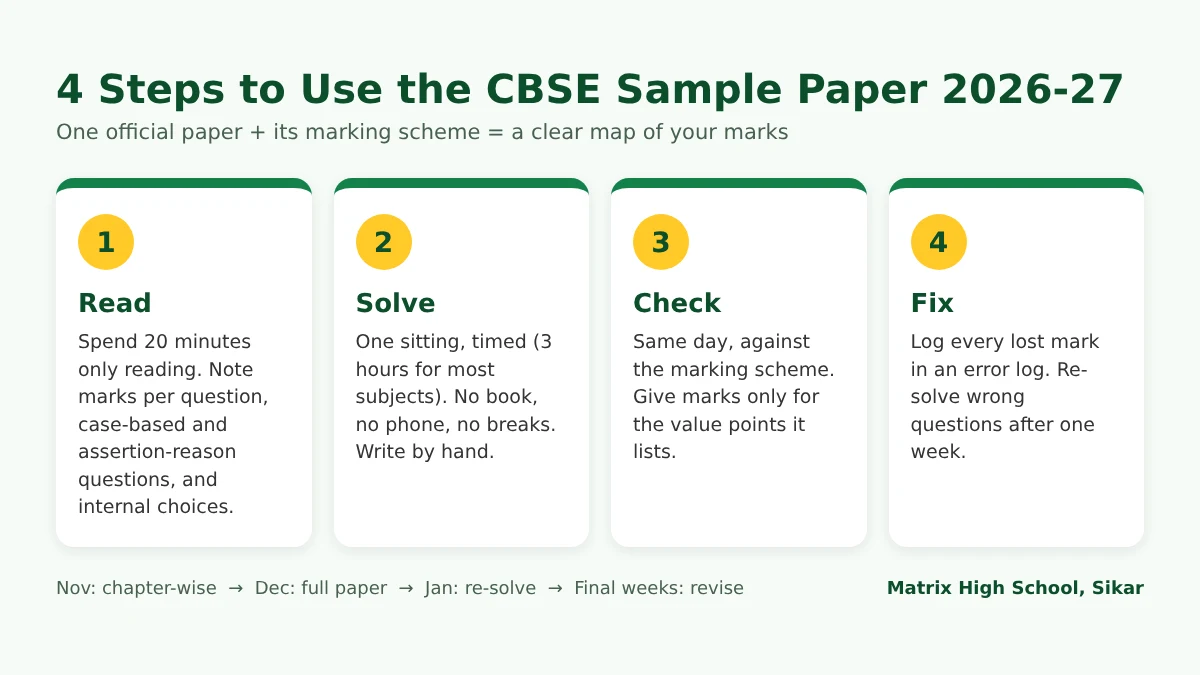
Spend your first 20 minutes with a new sample paper only reading it, because the paper design tells you where the marks sit. Note how many questions carry one mark and how many carry three or five. Then find the case-based and assertion-reason questions, since these need a different way of thinking.
Pay extra attention to these question types. In both Class 10 and Class 12, 50% of each theory paper is competency-based. CBSE fixed this share in its assessment circular (Acad-30/2024), and you can count these questions yourself in the 2026-27 sample paper. These questions test how you apply a concept to a new situation, not whether you remember a line from the book.
Next, look at the internal choices. They tell you which chapters can replace each other, so you can plan revision with less fear. Finally, mark every question from a chapter you have not finished, and keep it for later.
Solve It Like the Real Board Exam
Solve the full paper in one sitting, timed to the duration printed on it (three hours for most subjects), with no book, no phone and no breaks to check answers. If you stop to check even one answer, you lose the real test, because the paper should show how you perform against the clock.
Sit at a table with a timer and plain answer sheets. Write every answer by hand, because the examiner can only reward what they can read and follow. In Class 10 Science and Social Science, write each answer only in the section of the answer book it belongs to. CBSE introduced this rule from the 2026 board exams, and answers written in the wrong section are not evaluated.
| From Matrix classroomsMatrix High School faculty give board students three simple exam-hall rules. Once you start a section, finish it before you move to the next one. If the first one or two questions look tough, stay calm and attempt them at the end, because one hard question can make the whole paper feel harder than it is. Keep the last 10 to 15 minutes free to recheck your answer sheet. |
Check Your Answers the Way an Examiner Does
Check the paper the same day, while you still remember why you wrote each answer. Go through every answer against the marking scheme point by point, and give yourself marks only for the points it lists. The marking scheme does not just give final answers. It breaks each answer into value points and shows how many marks each step carries. So a three-mark answer with the right result can still lose marks if you skip steps. For example, a three-mark numerical may give one mark for the formula, one for the substitution and working, and one for the final answer with its unit. Jump straight to the answer, and you may get only one of the three.
Be strict here. Count a point you wrote in different words with the same meaning, but never one you left out. Each subject rewards slightly different things, so use this table while you check. It covers the main Class 10 and Class 12 subjects.
| Subject | What the scheme rewards | Where you lose marks | What to do |
| Mathematics | Each correct step, not only the final answer | Skipped steps, missing formula, no final statement | Write every step, even the ones you solve in your head |
| Science | Correct terms, labelled diagrams and units | Unlabelled diagrams, missing units, loose definitions | Learn NCERT terms and draw neat, labelled diagrams |
| Social Science | Separate, relevant points that match the marks | One long paragraph that hides the points | Write in points, one idea per point |
| English and languages | Correct format, relevant content and accuracy | Wrong format in letters or notices, crossing the word limit | Learn the format the scheme shows and stay within the limit |
| Class 12 Physics and Chemistry | Correct formula, every derivation step, units and balanced equations | Skipped derivation steps, missing units, unbalanced equations | Practise derivations step by step and balance every equation |
| Class 12 Accountancy | Correct format, working notes and narrations | No working notes, wrong format of journal or ledger, missing narration | Show working notes and narrations in every answer |
| Class 12 Economics, Business Studies and Humanities | Exact key terms, relevant points and labelled diagrams | Missing key terms, no graph in Economics, points that do not match the marks | Use NCERT terms, draw labelled graphs and write one idea per point |
Your checked paper now shows exactly where your marks went. Circle every lost mark in red, so you can find each one quickly when you build your error log.
Turn Every Lost Mark Into a Lesson
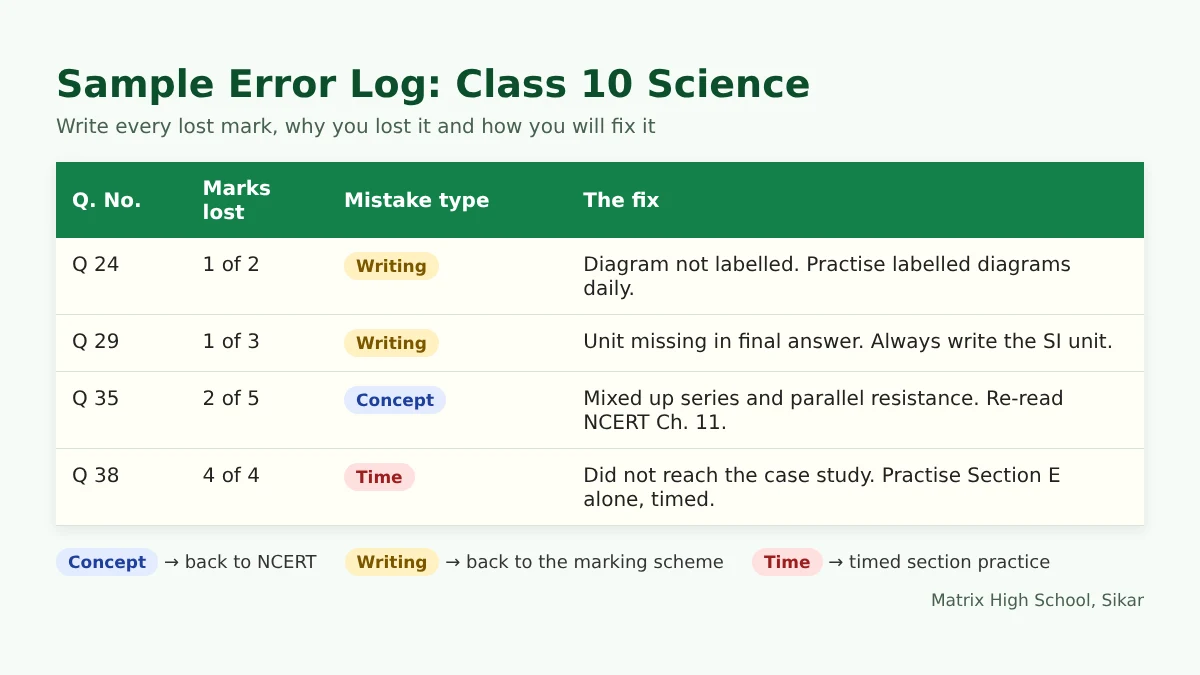
Keep an error log, a notebook where you write down every mark you lost and the reason you lost it. Draw four columns: question number, marks lost, mistake type and the fix. Sort each mistake into one of three types. A concept mistake means you did not understand the topic. A writing mistake means you knew the answer but missed a step, a keyword or a diagram. A time mistake means the clock ran out before you reached the question.
Each type needs its own fix. Concept mistakes send you back to NCERT. Writing mistakes send you back to the marking scheme, while time mistakes call for timed practice of one section at a time.
“Do not practise until you get the right answer. Practise until you understand why the answer is right. Your mistakes are not really your weakness. They are your personal question bank.”
Saurabh Pareek Sir, Senior Faculty (Chemistry), Matrix High School
Watch more from Saurabh Sir: Board Exam Study Tips by Saurabh Pareek Sir
After one week, solve the same paper again, but only the questions you got wrong. If you now score full marks on them, you have closed that gap.
A November to February Plan for Sample Papers
Use the sample paper chapter by chapter in November, as a full paper in December, for re-solving wrong questions in January, and only for revision in the final weeks. CBSE releases only one official sample paper per subject, so do not use it up in the first week. Check the CBSE board exam date sheet and count back your weeks.
| When | What to do with the sample paper |
| November | Solve only the questions from chapters you have finished. Check them with the marking scheme. |
| December | Solve the full paper once for each subject under exam conditions. Start your error log. |
| January | Re-solve every wrong question. Add previous year papers for extra timed practice. |
| Final weeks before the exam | Start no new chapter. Revise your error log and the answer style the marking scheme rewards. |
To fit this plan into each day, follow a daily study routine for Class 10.
Mistakes to Avoid With Sample Papers
Most students waste a sample paper in three ways, and each has a simple fix.
1. Solving it too early
What students do: They attempt the full paper with half the syllabus done. Why it hurts: A low score shakes confidence and wastes a fresh paper. Fix: Keep the full attempt for December. If a low score still shakes you, read how to handle exam stress.
2. Checking only the final answer
What students do: They match the final answer and skip the marking scheme. Why it hurts: They never see the steps that carry marks. Fix: Check every value point.
3. Solving it once and forgetting it
What students do: They file the paper away after one attempt. Why it hurts: The same mistakes return in the board exam. Fix: Re-solve wrong questions after a week.
Conclusion
You started with a sample paper that most students solve once and forget. Now you know that the marking scheme turns that same paper into a clear map of your marks. Read it first, solve it against the clock, check it like an examiner and log every lost mark.
Spread that work from November to February, and one paper can guide your revision right up to exam day. Board exams reward clear answers, not just correct ones. Tomorrow, download the sample paper for your weakest subject and spend 20 minutes only reading it. If you want this kind of guided board preparation every day, explore Matrix High School’s residential programme.
FAQs
You can download them free from the CBSE academic website for Class 10 and Class 12. Each subject has its own sample paper and marking scheme. Always use these official files before any guidebook.
No single paper can promise a score. Sample papers show you the pattern and the marking style, but you still need strong NCERT study. Combine them with previous year papers and a regular error log. For more, read our tips to score high in board exams.
Solve it fully once under exam conditions. After a week, solve only the questions you got wrong. Before the exam, read through it once more with the marking scheme.
Do not expect the same questions. The sample paper shows you the type of questions and the paper design. Prepare the full syllabus and use the paper to practise the pattern.
Yes, older marking schemes show you how CBSE rewards steps and keywords. The paper pattern can change between sessions, so always compare them with the current sample paper.